
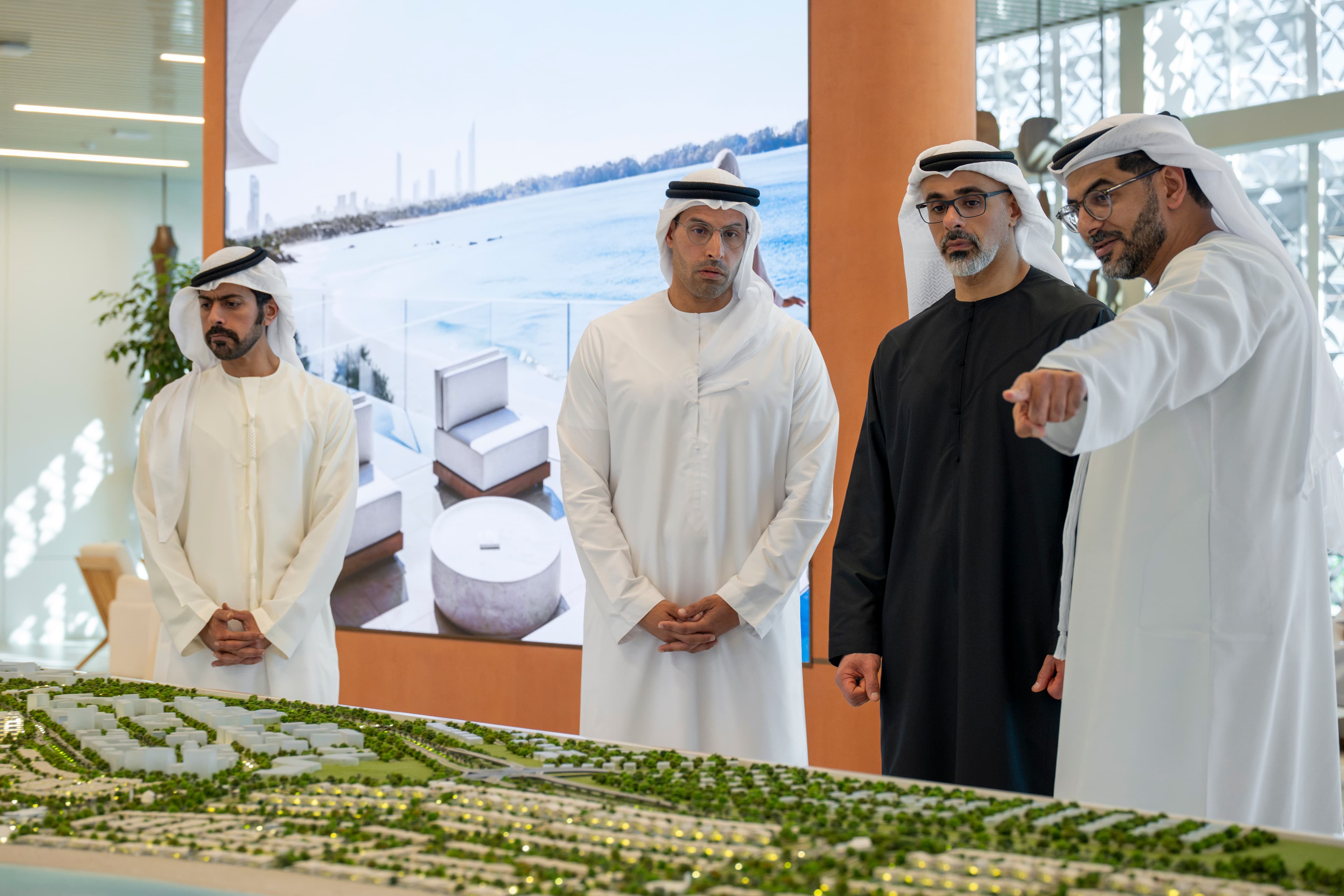
Aldar has unveiled Marsa Al Saadiyat, a waterfront destination carrying a gross development value of AED 100 billion, activating the final phase of Saadiyat Island's masterplan and establishing what the developer positions as one of the emirate's most ambitious residential and cultural mandates to date. The development spans 6.4 million square metres, a scale that places it among the largest integrated coastal precincts currently under way in the Gulf.
The destination was inaugurated by His Highness Sheikh Khaled bin Mohamed bin Zayed Al Nahyan, Crown Prince of Abu Dhabi and Chairman of the Abu Dhabi Executive Council, who visited the project launch site to view the masterplan accompanied by Aldar's Chairman His Excellency Mohamed Khalifa Al Mubarak, and Group Chief Executive Officer Talal Al Dhiyebi. Sheikh Khaled also directed that the development be renamed from Saadiyat Marina District to Marsa Al Saadiyat. The name reflects the UAE's maritime heritage and the project's centrepiece: Abu Dhabi's largest marina, with capacity for up to 350 sailing boats and luxury yachts.
The structural thesis is clear — Aldar is master developer, responsible for overall design and delivery of primary infrastructure, with the first residential inventory scheduled to reach the market in the second half of 2026. The first homes go on sale in the second half of 2026, with infrastructure works beginning in the third quarter. That timeline compresses the gap between announcement and absorption, a departure from the multi-year lag that characterised earlier phases of Saadiyat's build-out.
The destination will extend across eight kilometres of waterfront, including 5.6 kilometres of beaches. Its homes, hotels, schools, cultural facilities, parks and commercial areas are expected to serve more than 58,000 residents. The residential offering spans multiple typologies — private mansions, luxury villas, waterfront apartments and branded residences, alongside a hillside villa enclave designed to maximise views across the surrounding landscape. No pricing, payment plans, or unit allocations have been disclosed; the masterplan announcement remains distinct from confirmed inventory.
The amenity infrastructure is sovereign-backed in ambition. The masterplan includes about 140 kilometres of interconnected walking paths and a 46-kilometre cycling track. Designed so that daily life unfolds within the community rather than outside it, the masterplan is woven together by a network of green linear parks, anchored by a landscaped central park that extends to the waterfront, children's play areas, community clubhouses with outdoor pools, sports courts, premium healthcare, and three schools, ensuring that amenities are never more than a walk, cycle or short drive from home.
The cultural catalyst is Dar Al Funoon, a performing arts venue announced separately in June 2026 but integrated into the Marsa Al Saadiyat masterplan. A theatre district will be anchored by Dar al Funoon, a performing arts venue with capacity for more than 6,000 guests. It is planned to host musicals, live productions and international performances throughout the year. The project will include a multipurpose performance hall with more than 2,000 seats, a 3,500-seat open-air amphitheatre, a 400-seat studio theatre and a 250-seat jazz venue — with a total capacity exceeding 6,000 across its artistic spaces. The venue is scheduled to open in 2030, designed by the late Frank Gehry.
A one-kilometre promenade will form the development's main retail and dining district. Marsa Al Saadiyat will also contain a yacht club and two luxury hotels, creating a commercial and leisure centre around the marina. A scenic walkway will connect Marsa Al Saadiyat directly with the Saadiyat Cultural District, giving residents access to its museums, restaurants and hotels. The cultural district includes Louvre Abu Dhabi, the Natural History Museum, Zayed National Museum and teamLab Phenomena Abu Dhabi. That pedestrian link is structural — it positions Marsa Al Saadiyat not as an isolated marina enclave but as an extension of the island's existing cultural precinct, with walkable access to institutions that anchor Saadiyat's positioning in the global museum circuit.
Transport infrastructure includes a planned underground Etihad Rail station. It will also include an Etihad Rail underground high-speed rail station. The station would connect Marsa Al Saadiyat to the wider UAE rail network, compressing travel time to Dubai and other emirates once the passenger service is operational. That connectivity is a basis-point advantage over earlier Saadiyat developments, which relied exclusively on road access.
The market context is instructive. Official ADREC figures put total 2025 real estate transactions at around AED 142 billion, with residential sales near AED 76 billion, while REIDIN's index recorded Abu Dhabi residential prices up close to 28% year-on-year in April 2026. Saadiyat has been at the front of that move, with data pointing to roughly 20-30% price growth over the past year and gross yields in the 4.5-5.5% band, below mid-market communities such as Al Reem or Al Reef. Yield compression reflects capital appreciation and a shift in buyer profile — Saadiyat increasingly attracts end-users and long-term holders rather than speculative flippers.
Mohamed Khalifa Al Mubarak, Chairman of the Department of Culture and Tourism – Abu Dhabi and Chairman of Aldar, said the development would open a new stage in Saadiyat Island's expansion. "Marsa Al Saadiyat marks the activation of the final phase of the Saadiyat Island masterplan, and with it, the beginning of the most ambitious chapter yet in the island's evolution," Al Mubarak said. "Abu Dhabi today stands among the world's most compelling destinations for long-term capital, offering a combination of long-term vision, economic momentum, and a quality of life that continues to attract the most discerning investors and residents from around the world."
Talal Al Dhiyebi, group chief executive officer at Aldar, stated: "Marsa Al Saadiyat is a landmark development for Abu Dhabi, reinforcing the emirate's emergence as a powerful force in the global luxury landscape. With a development value of 100 billion AED, the masterplan will add significant scale and character to the island, a destination already recognised as one of the most compelling cultural and lifestyle addresses in the world."
The AED 100 billion figure is gross development value, not committed capital expenditure. It represents the aggregate sales value Aldar anticipates over the full build-out, which will unfold in phases across multiple years. The secondary-market implications are material — existing Saadiyat inventory, particularly older villa stock in Saadiyat Beach Villas or apartments in St. Regis and Park View, may see price compression as buyers defer purchases to await Marsa Al Saadiyat releases. Conversely, proximity to the new marina and cultural amenities could create a halo effect, lifting values in adjacent precincts.
For UHNW allocators, the thesis hinges on execution risk, payment-plan structure, and handover timelines — none of which have been disclosed. The masterplan is compelling on paper, but the individual project economics will determine whether Marsa Al Saadiyat delivers alpha or simply tracks the broader Abu Dhabi residential index. The mandate is clear: Aldar is positioning this as the archetype of integrated waterfront living in the emirate, a precinct where culture, nature, and residential density converge at scale. Whether that thesis holds depends on the granular details still to come.
Why this may matter.
The structural thesis is clear — Aldar is master developer, responsible for overall design and delivery of primary infrastructure, with the first residential inventory scheduled to reach the market in the second half of 2026. The first homes go on sale in the second half of 2026, with infrastructure works beginning in the third quarter. That timeline compresses the gap between announcement and absorption, a departure from the multi-year lag that characterised earlier phases of Saadiyat's build-out.
This passage is excerpted from the report above. It is contextual analysis, not an independent source or a promised outcome.