
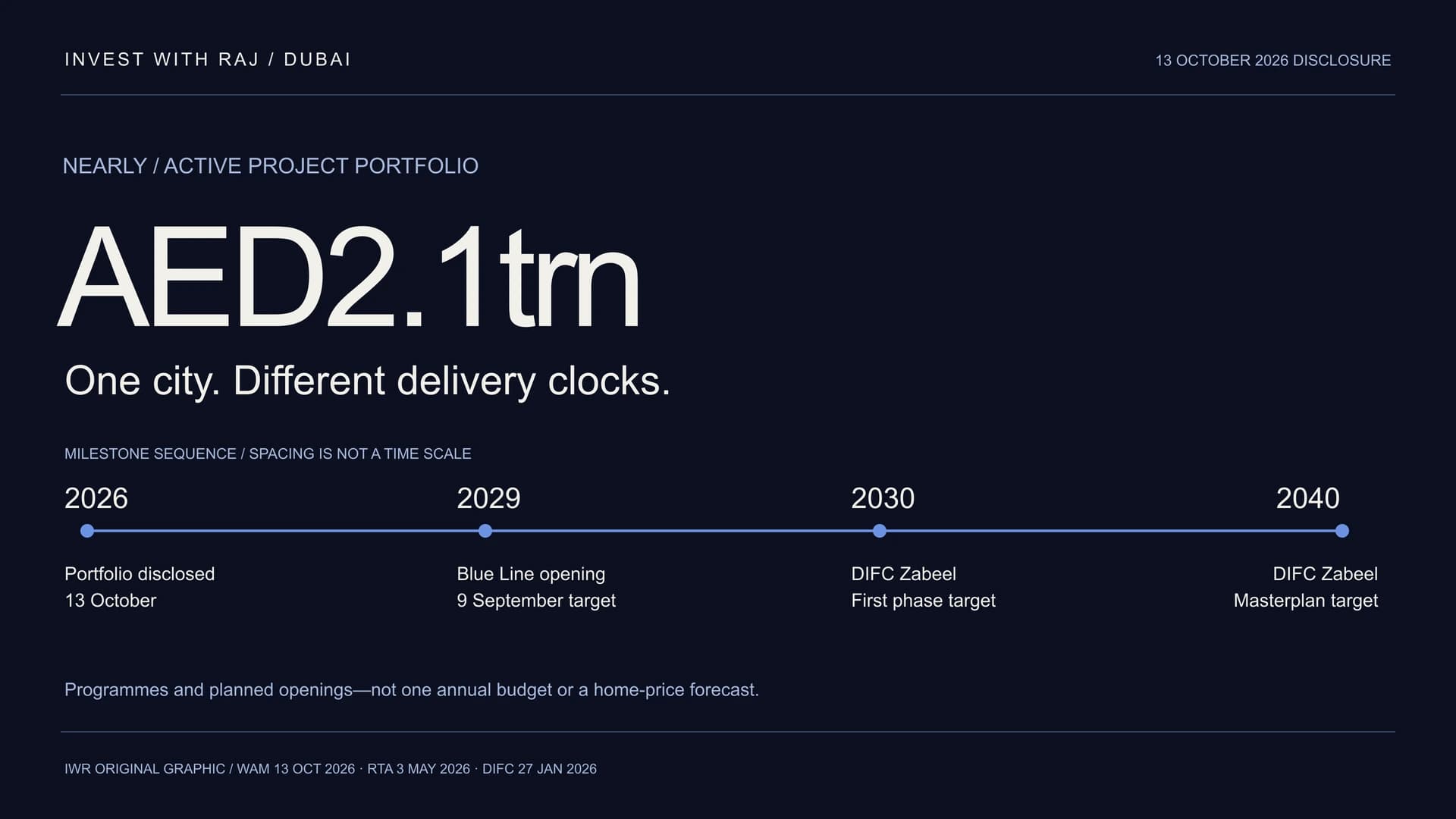
Dubai disclosed nearly AED2.1 trillion of ongoing projects at the Mohammed bin Rashid Leadership Forum on 13 October. WAM’s official account places housing alongside transport, aviation, utilities and economic development. The announcement is significant because it presents the city’s expansion as a connected portfolio, rather than a succession of individual property launches.
The account includes AED1.1 trillion of real estate projects through 2030 and approximately 350,000 planned residential units. It does not give every home one completion date. Selected programmes include AED128 billion for Al Maktoum International Airport, AED151 billion for power and water grids, and AED100 billion for roads and the Metro Blue and Gold lines.
A portfolio is not an annual budget
These amounts should not be read as spending taking place in a single year. Nor is every figure a construction bill. DIFC’s January announcement, for example, describes Zabeel District’s AED100-billion-plus scale as estimated gross development value. GDV is a different measure from the capital required to build a scheme. Fleet purchases, utility investment and property development also reach the economy through different channels. Adding separate headlines to the portfolio total can therefore double-count programmes rather than reveal extra investment.
For residential buyers, the useful distinction is between the city’s capacity to expand and the income or occupation available from a particular home. An announced investment programme may improve a location’s future connections, but it does not establish current occupancy, achieved rent or the operating costs of the selected building.
One city, different opening dates
The delivery timetable makes that distinction concrete. DIFC launched Zabeel District on 27 January, with six development phases: the first expected to open in 2030 and the masterplan expected to complete in 2040. That is a staged employment and mixed-use destination, not a completed extension of today’s office district. Its planned capacity cannot be counted as professionals already working there.
The Metro Blue Line has its own programme. RTA’s 3 May tunnelling announcement describes a 30km route with 14 stations and an opening target of 9 September 2029. The route serves several residential and academic districts, but a district’s inclusion does not put every building within an easy walk of a station. Access depends on the actual station entrance, pedestrian route and surrounding streets.
A home due before a transport opening may need to function without that future connection for part of its occupation or letting period. A later handover could align more closely with it, but the two schedules remain independent. For an owner, this is a reason to compare the delivered neighbourhood and the current tenant’s alternatives—not simply attach a transport premium to an asking price.
Connect the programme to the actual home
The same programme creates both support and competition. Utilities and mobility can enable new neighbourhoods; the homes delivered into those neighbourhoods can expand tenants’ choices. The size of a planned housing programme does not tell us how many comparable apartments will enter one building’s catchment in one year. Local product, timing and household budgets still matter.
The next useful milestones are specific: contracts awarded, construction progress, phase openings and completed homes, followed by comparable registered sales and leases. Yesterday’s portfolio disclosure gives a broad view of Dubai’s development capacity. Turning it into a property decision requires matching the home’s delivery, payment commitments and expected use to the relevant project’s actual clock.