
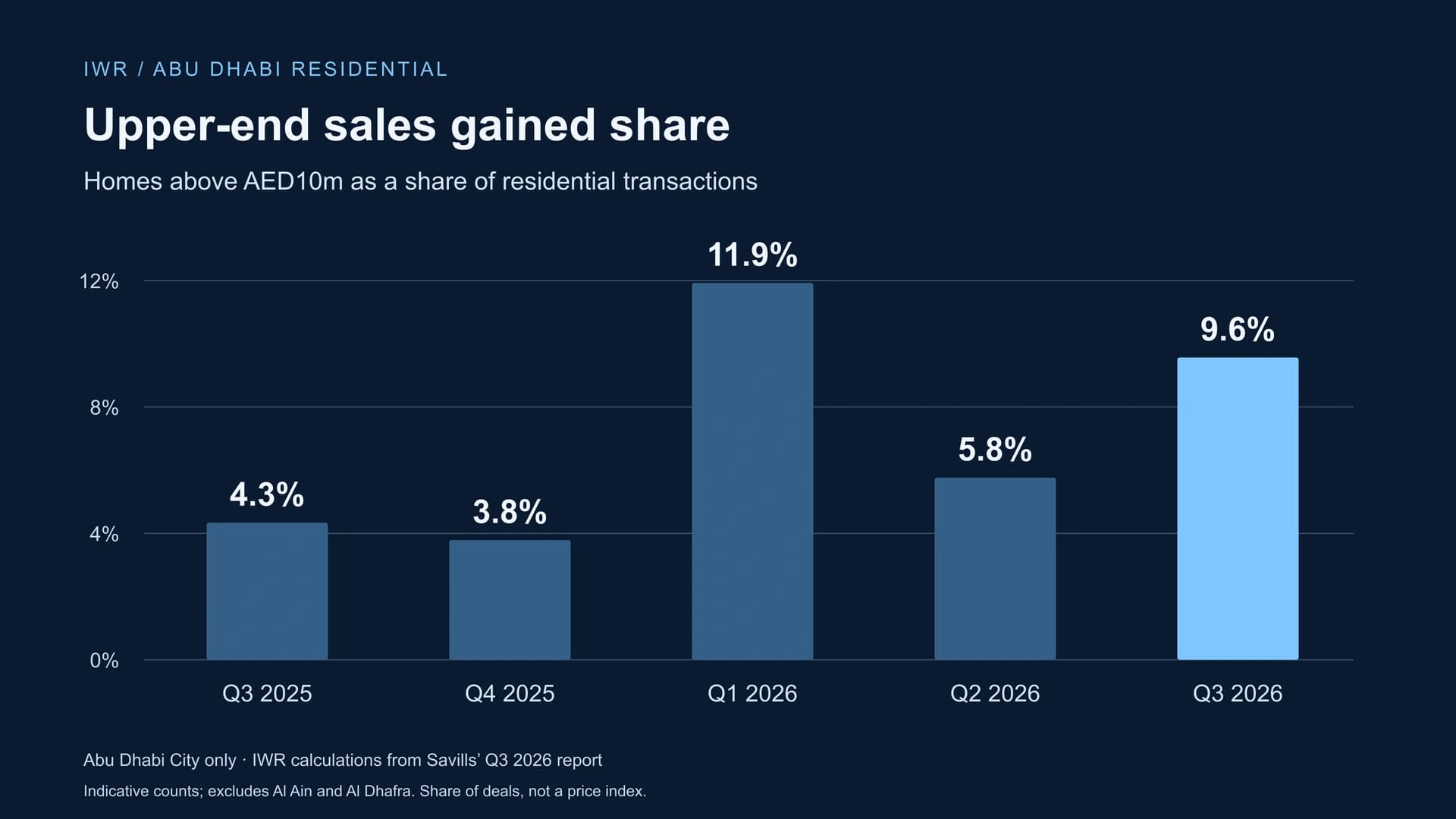
Abu Dhabi’s upper-end housing market recovered some of its first-half momentum in the third quarter, even as overall deal activity fell. Savills’ residential report, published on 14 October, estimates 582 sales above AED10 million in Q3, up from 431 in Q2. The first quarter was stronger still, at 984. The latest count is therefore about 35% above Q2, but 41% below Q1.
The report covers Abu Dhabi City, excluding Al Ain and Al Dhafra. Its figures are indicative estimates based on ADREC data, cross-checked against Quanta, and may reflect reporting lags. Within that same scope, total residential transactions fell from 7,478 to 6,085 between Q2 and Q3.
A rebound and a change in mix
Dividing the higher-value count by all residential deals produces a useful comparison: sales above AED10 million represented about 5.8% of transactions in Q2 and 9.6% in Q3. More expensive homes gained share while the wider count contracted. These are IWR calculations from the report’s quarterly counts, not a separate price index.
This distinction changes how a buyer should read a market headline. A greater concentration of expensive homes can lift an average ticket even when an equivalent apartment has not become dearer. A purchaser needs evidence about comparable homes—similar floor area, outlook, condition and completion status—to test a seller’s asking price. A citywide shift towards larger or higher-specification properties cannot answer that question on its own.
Concentration matters more than the city average
Concentration was already visible in earlier official evidence. ADREC’s H1 report, released in August, found that ten projects accounted for 43% of residential unit sales value across the emirate. That is historical, emirate-wide value data, not a directly comparable Q3 City deal count. It provides a reason to investigate which projects are driving activity; it does not identify the cause of the latest quarterly rebound.
For a shortlist, the practical comparison is between the selected home and the alternatives available to the same buyer or tenant. A waterfront villa and a smaller inland apartment serve different budgets and households. Their inclusion in one market total does not make them substitutes. Local resale evidence, competing releases and the depth of the relevant letting market are more informative than applying one upper-end headline to both.
An off-plan sale is a different cash-flow event
Savills estimates that 95% of Q3 sales above AED10 million were off-plan. A contract for a future home can demonstrate buyer commitment, but it is not evidence of rent currently being collected from that home. The payment schedule and expected completion date determine when capital is committed and when occupation or letting can begin. A completed property offers a different comparison: the actual building, its charges and, where tenanted, the existing lease.
The next quarterly release should be read alongside project-level transactions and delivery progress. The question is whether higher-value activity broadens across comparable homes or remains concentrated in particular launches. For now, the figures support a narrower conclusion: the upper end regained activity from Q2 and a larger share of a smaller market, without returning to its Q1 transaction peak.